6 Ways to boost sales with better segmentation in your retail marketing

Knowing your customers is key to creating effective marketing campaigns and promotions.

There are myriad ways to slice your retail data, so how can you form smart segmentations that will help you deliver tailored marketing messages to relevant group of customers for higher redemption rates and sales?

As a retailer, you are collecting lots of useful data through your Retail Pro POS. OptCulture Marketing for Retail Pro is the tool that allows you to use that data in a way that facilitates a higher level of customer engagement leading to increased revenue for your business.
OptCulture provides retailers with a complete suite of solutions that integrate directly with your Retail Pro point of sale system and ecommerce platforms, giving your customers a full circle experience with loyalty and promotions.

Customers that enroll online can redeem points in-store and customers that earn rewards in-store can redeem online.

OptCulture also offers loyalty mobile applications that can display the latest offers for customers as well as keep them up to date on rewards earned through recent purchases.

Using integrated data in your OptCulture Marketing for Retail Pro, you can create better segments that will help you boost sales.

Segmentation

Segmentation is basically an elaborate way of describing the filtering of customers.

Which of your stores is their go-to location? What are they buying? How often are they opening and clicking through emails?

These are just the basics. The real fun begins with asking the right questions.

Where to start

Think of the different products your store sells.

Do your customers exhibit brand loyalty? Are there different genders that purchase from different departments? What is the average purchase amount per customer? How often are your regular customers visiting the store?

All of these questions lead to better answers when it comes to communicating and advertising to your market base.
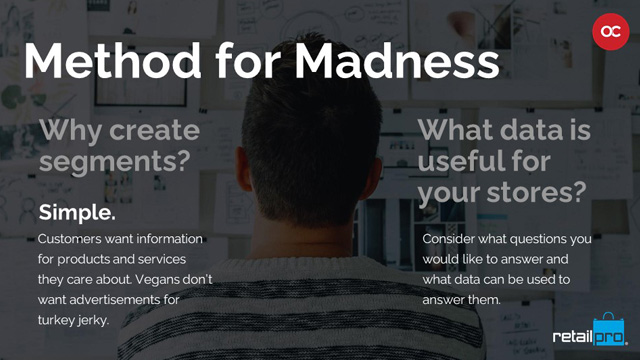
Why should you do this? In today’s data driven marketing environment, customers simply do not engage with advertisements for things they are not interested in.

If I have only bought Nike shoes from my local shoe store and they keep sending me advertisements for Adidas shoes, New Balance, Vans, etc.,  I am very  unlikely to engage with those communications and may just unsubscribe altogether.

The process

Consider your inventory and what products you see customers purchasing or not purchasing.

As a sports clothing retailer, segment your customers based on the team that they support.

Look at sales reports, is there a day that is always slow? Consider running double rewards on these days.

What questions do you have and how can the data you are collecting be used to answer them?

What follows next are the 6 easiest examples of customer segmentation that every retailer should be doing, and then we’ll look at post-campaign analytics which will help refine our next steps in the overall marketing plan.

This first example is a very easy segment to set up. Think of how often your average customer shops. Is it once every 3 months, every 6 months, once a year? Then let’s take those rules and go right on into OptCulture and create the segment.

For this example I have created a segment for customers that have made less than 2 purchases and have not shopped with me in the last 6 months.

To do this I simply click on the rule I would like and drag it into the appropriate area. Rules can be combined in an “and” fashion as well as an “or” fashion. 

I can now target these customers every 6 months with an automated email or SMS message and include an offer in attempt to get them back into the store

Our second example relates to items in  your store.

Are there products that your customers need to replenish or refill? Customers that shop for products that have limited lifespans will need to buy more at some point.

Think about tire shops. When you get new tires in Houston, after a few months I will get a reminder for balance and rotation and then a few months later an advertisement for all new tires. All retailers should be doing the same things in regards to their products.

Here’s another example: High performance surfboards last at most a year or two.

Segmenting out customers who purchased that product within a particular time frame gives me an idea of who should be coming back in for a new one. If they have not, I could create a call list for my staff to reach out to.
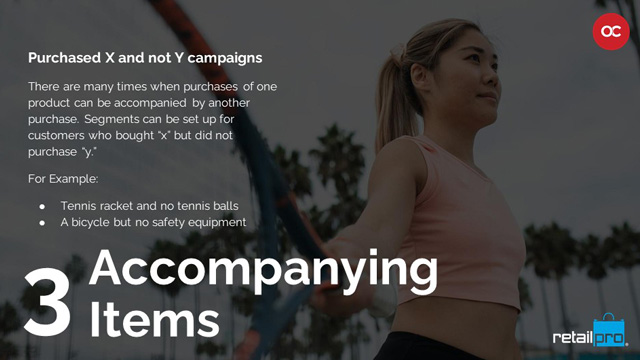
The third example also relates to products. Are there items that are typically sold together? Shoes and socks? Kayaks and paddles.

Think of products you sell that go together and come up with some rules that you can take to OptCulture.

An example we came up with would be if a customer purchased a bike but without making a purchase for a Helmet.

Reach out to them with an email advertising safety equipment that is important for bike riders, or even places to ride their new bike and groups to meet up with.

Our Fourth example is going back to customer behavior.

What seasons or months are most important to your business? Are there holidays that your customer base shops on? Mothers Day? July 4th?

Create a segment for them and advertise products that are popular for that season.

Here we created a segment for customers that shopped prior to Christmas and we also added a rule that targets customers who on average spend $100 or more.

This will give us a good group of customers to reach out to when we know what we will have in stock for the Christmas season.

In this fifth scenario, we look at items that require special care or warranty information to be filled out.

In the event that a garment requires special care, with OptCulture you can follow up that purchase with an automated email or SMS explaining exactly how to care for that product.

Are there items your store sells that require customers to fill out warranty information?

In the example of a bike store, customers who purchase high end bicycles fill out warranty forms that are returned to the manufacturer. Make this process seamless by automatically emailing these customers the details that relate to their warranty.

Here we created a segment for customers that purchased a silk item the previous day.

This segment can be attached to a daily email campaign and customers who fit that criteria will be sent the necessary email. This is just a simple example.

Any information you are bringing into Retail Pro can be mapped to OptCulture so that you can segment out exactly the customers you are looking for.

6th and last on our list, while certainly not least, relates to segmentation based on customers interacting with your communications.

Consider the seasonal email you just sent out for summer items.

What was the open rate? Were there any clicks?

Why not reach out to those who clicked through the original email with a follow up in a few weeks?

Even better, reach out to those who clicked but did not make a purchase. Their click expressed interest; segment them out to see if they acted on that interest. 

Refining segments

Once you have put together some segments and run some campaigns, look at your reports. Are these groups coming in and making a purchase?

Create a segment for customers who opened the campaign and add purchase rules and find out.

Consider expanding the rules to include more or less customers.

Discover what is working by looking at promotional redemptions for customers who have been sent exclusive offers.

Continue to ask questions and to use your data and OptCulture to maximize engagement and increase revenue at the same time.

A quick look at the email reports dashboard will show you if customers are opening and clicking through emails.

Clicking on the name of the campaign will take you into more detailed reports such as how many opens or clicks for a given time period, or even what devices customers are using to view emails.

So let’s talk. Give OptCulture a call to discuss how you are currently marketing to your clients and how using segmentation can help your business increase customer engagement.


About OptCulture®

OptCulture Marketing for Retail Pro helps specialty retailers improve customer loyalty and engagement with their brand via customizable, omnichannel marketing. Capabilities and features include: Omnichannel loyalty, digital receipts, email & SMS marketing, campaigns & automation, custom promotions, ecommerce purchase data integration, mobile client app for accessing rewards, tablet or kiosk for in-store loyalty signups, analytics, and omnichannel customer data management.


Build your omnichannel operations on Retail Pro Prism

Retail Pro Prism is fully customizable, integrable POS and retail omnichannel operations management software that helps retailers improve efficiency in inventory, customer, and store operations management across channels.

Whether you operate as a franchise, corporate store, outlet, or multi-subsidiary retailer, you can overcome data fragmentation and configure Retail Pro to your exact workflow, branding, and business needs.

Application Screen icon with data

Full-Featured Enterprise POS

Expand what your POS can do with complete access to customer details, gift card balances and promotions while benefiting from native offline capability and enhanced security.

Integrated Software

Use open APIs to integrate data from third-party solutions including ecommerce, loyalty, ERP, CRM, accounting, and any other tool you use.

circle with squares at top bottom and sides symbolizing all the different softwares integrated to RPP
icons of two storefronts with arrows  to each other

Omnichannel Order Fulfillment

Create sales at one location and fulfill the order at any other location, as part of your BOPIS, Click and Collect or other omnichannel efforts.

Browser-Based POS for Uncompromised Mobility

Empower associates to complete transactions and inventory tasks anywhere on the sales floor with your choice of Windows, Android, or iOS devices.

multi device icon - 3 different sized rectangles overlapping to symbolize a cell phone, tablet and laptop
icon of a tablet and a paintbrush

Configurable User Interface

Increase transaction speed and efficiency by customizing
the user interface with your exact checkout workflow
and preferences.

Centralized Inventory Management

Save time on inventory management with robust style definition grids and centralized control that allows you to have complete visibility across all locations and online.

icon of an application screen with an organizational system with three squares connected to another singular square above them

Automated Replenishment & Transfers

Increase inventory turn and keep your shelves fully stocked with automated inventory transfers between stores and best replenishment features.

Contact us today to schedule your full demo and needs analysis.

Enhancing the In-Store Shopping Experience With a Loyalty Program

Guest post from Antavo

In-store promotions are designed to attract customers to brick-and-mortar stores, build brand or product awareness and provide benefits that online shopping simply just cannot give them. If customers are not visiting the store they might be missing out on special promotions, discounts or free giveaways. 

Also when customers shop at a local business, they are strengthening the local economy as well. 

In order to compete with eCommerce, loyalty programs for physical stores have to be more than just membership cards. Creating a loyalty program is a great way to effectively strengthen your brand image, connect with your customers, improve your retention and drive more in-store sales. Following the pandemic touchless solutions are playing an essential role in the in-store experience. It is crucial that retailers show customers that they are invested in their safety as stores reopen.

Enroll Customers Into Your Loyalty Program In-Store In a Fun Way

Show customers how your in-store location is just as enjoyable as shopping online by:

  • Vivifying the thrills of shopping in person via allowing your customers to browse your online shop in your physical location 
  • Implementing click and collect 
  • Making sure your physical and digital stores work together
  • Letting your customers interact with your products 

Also, reward your returning customers with a loyalty program by offering discounts after a certain amount of visits, access to special in-store events and other perks. If they like the program they are more likely to recommend your store to friends and their families.  Special offers by push notifications, personalized offers will help you enhance brand experience. 

Bridge the gap between offline and online customer interactions with digital loyalty cards, which is an effective solution to boost in-store engagement and reach more customers through location-based messages, thereby driving multiple business KPIs.

Experiential Retail 

According to a study by Deloitte experience has become the differentiating factor for businesses. Over 50 percent of customers say that the overall enjoyment of the shopping experience was important when making their final decision. When customers visit a store and are offered experiences such as large video display walls, a cafe, kids’ corner, virtual reality they will want to return. All these create a memorable experience and soar customer expectations.

Retailers can engage with in-store customers by enriching the offline customer journey, by offering them fun, easy and convenient ways to interact with gamified features. For instance, an offline treasure hunt, where customers need to find marked treasures or products inside the store, then use their mobile to scan the item’s barcode for a reward. You can prompt customers to thoroughly inspect the whole store, ensuring that they discover products or sections they would have overlooked otherwise. Send customers a push notification inviting them to play a fun game and win rewards. A Prize Wheel is ideal for mobile apps if you prefer touchless engagement for in-store devices. Showcase the prize wheel on an in-store device to instantly catch customers’ attention. Customers can approach the wheel and take a spin, giving you a new way to engage them.

A Prize Wheel is ideal for mobile apps and for in-store devices as well.
After spinning the wheel and landing on a reward, customers are asked to log in or enroll in the loyalty program to redeem it. This ensures that they identify themselves while shopping.

QR Codes  

Implementing a touch-free solution like QR codes on brochures or on signages in different areas of the shop, on the counter or in the dressing rooms, is a great way to make customers aware of your loyalty program. You might consider putting a QR code on the tags of your most popular products, so customers can scan it with their phone and receive a reward in return such as a small gift at the counter or a sum of loyalty points. Make sure to let the customer know that upon scanning the QR code they get rewarded.

DSW, the American branded footwear and accessories retailer featured QR codes on their magazine ads to engage customers. When customers scan the QR code they are taken to the DSW’s mobile site, where they can find the store nearest to them to view the products in person, check their order status, view DSW’s rewards program, and redeem their loyalty points, or make a purchase then pick up their order curbside, completely contactless.

The visual design of Timberland’s Manhattan flagship store
The NFC technology helped Timberland increase customer engagement. The store could track, analyze and interpret their shoppers’ behavior

NFC Technology

NFC technology is a great way to spice up in-store customer engagement. With its help, you can create novel in-store experiences. It allows retailers to connect quickly and easily with customers at every step of the customer journey. In a loyalty program, NFC enables people to use their smartphones to interact with store-exclusive loyalty program features. 

In Timberland’s Manhattan flagship store around 50 percent of the store’s inventory had been equipped with NFC tags. Upon tapping information about the product came up on the screen. The NFC tag was integrated to collect data from the customer. The store started adding credit for customers who signed in on the tablets, adding an extra touch to the customized shopping experience.

Beacon Technology

Beacon technology boosts customer experience by increasing efficiency, providing money savings, convenience, inspiration, and personalization. With targeted ads and brand offers, notifications and greetings on special occasions, you can add value while increasing trust. With just a single beacon near the entrance of a store, you could send a promotional notification to the user whenever they enter it or track how many users come to the store in a specific timeframe. 

Target, the American retail corporation, is using beacon technology to help in-store customers to use Target’s app to create shopping lists, and then see where items are located in-store. As they move, their location changes in real-time, showing them whether they’re getting farther or closer to the product.

Target’s application will show your location on the map
The new Target application will actually show your own location on the map, as indicated by a blinking dot. As you move through the store, your location will update, too. (Source: TechCrunch

Introduce a Kiosk In-store

Self-service kiosks are a rising component of in-store technology. It gives customers the possibility to shop for both the physical and online product offerings. They help shoppers gather information and speed up the shopping process. In-store kiosks are also a great way to promote a loyalty program. You can either set up a kiosk where waiting customers typically gather or offer priority lanes as a members-only feature. It is also an excellent solution to make sure customers are entertained while standing in line. 

In order to help the customer as much as possible in finding products and to prevent lost sales, the ANWB,  a travelers’ association in the Netherlands, needed a new solution to offer customers products that are not yet in stock. The kiosk has almost the same performance as the webshop on a PC, but the navigation especially works in terms of visual language and icons.  By adding NFC technology to the kiosk retailers can ensure contactless touch screens for the customers making in-store shopping even safer in the post-pandemic world.

ANWB’s in-store kiosk makes sure that their full online catalog is accessible
With the in-store kiosk ANWB makes sure that their full online catalog is accessible. (Source: Kega)

Sales Associates

Obviously, human interaction has a great impact on a customer’s emotional connection to a retailer. It will be especially of outstanding significance following the pandemic when everyone is craving a return to normal face-to-face communication. Well-trained sales associates can help boost loyalty program membership rates, as one of the easiest ways to inform your customers about your loyalty program and how their today’s transaction will get them closer to earning exciting rewards.

The Douglas perfumery chain’s loyalty card, called the Beauty Card, makes it possible for the company to serve their customers in a much more personalized way both online and offline. Besides offering several benefits, such as birthday surprises, product samples and invitations to exclusive events. They also offer makeup refreshing, skincare services, and beauty tips in-store.

A sales associate is giving makeup tips to a customer in a Douglas store.
In Douglas stores, customers can collect Beauty Points on their Beauty Card with each purchase, regardless of where it takes place, at the brick-and-mortar store, online or via their smartphone. (Source: ixtenso)

Brick-and-Mortars Coming Back to Life

Following COVID-19 face-to-face interactions will be receiving an even greater emphasis, as customers are hungry for communication. As shopping has evolved dramatically over the past several decades, the competition between retailers is fiercer than ever. Customer buying behavior is constantly shifting, not only when it comes to in-store shopping but online shops have also joined the race for customers, providing them with more choice and convenience. 

Nevertheless, it is important not to overlook your stores as a crucial touchpoint in generating long-term customer loyalty. While customers are growing more comfortable with online shopping every day, the in-store experience isn’t going away anytime soon.


Reopening your stores: optimize these 5 areas first

Stores are starting to reopen across the world, and we are watching this very, very carefully. 

We’re learning a ton of new things while watching what they are doing, because some of these stores are doing excellent business. 

In some cases, they are exceeding last year’s numbers!  Let’s take a look at what the most successful retailers are doing to make this happen. 

Overall, you have to approach opening as if you were opening for the first time. 

It has to have that level of excitement, that level of enthusiasm. 

So my first, best advice to you is to get super pumped up about opening! 

1. Store Presentation and Layout

This is the perfect time to reassess your store’s layout and shop-ability. 

You certainly want to organize your store so your shoppers can maintain the proper social distance from each other and still see all the great merchandise you have in stock. 

Here are some tips you can apply:

  • Start at the front door, and look inside your store as if you’re visiting for the first time.  Can you see all the way to the back wall? Can you identify key areas that you want to go to to see the merchandise?
  • The most important real estate in your store is the immediate right. Do we have some of our best merchandise there?
  • Many stores are putting markers on the floor that direct people through the store, creating a path to follow, much like grocery stores or Ikea have done. The benefit of this is that when your shoppers walk the path, they can see merchandise they might not have seen.  This is creating add-on sales!
  • As you walk the store, make sure your displays make people want to stop and check out the merchandise. Make the displays compelling with cross-merchandising, props, bundles, and multiple levels.
  • From each display that causes a shopper to linger, where will they go next? Merchandise your displays that lead the customer through the store, directing their eyes to the next great display of merchandise.
  • Signage is super important. Yes, you want to have signs that remind people to obey social distancing, but they don’t have to be negative or serious. A western apparel store put up signs that say, “There should be a cow’s distance between us!” Another store posted a sign that said, “If you can read the label on my jeans, then you’re too close!” Make it fun!
  • This is also a time to ensure you have excellent lighting that shows off and spotlights your great products.

2. Marketing

For many years, I have said that marketing should have a two-word definition, which is “Creating Demand.”

That means that any messaging you send out, whether it be by email, social media, or texting, should first be checked to see if the message makes anyone want to come to the store or the website, or to find out more.

If it doesn’t, rework it until it does.

  • I think the best messaging for reopening is, “We are back, we are safe, and we are ready for you!” Customers need to feel like you are welcoming a long, lost friend to the store.
  • Show them in your videos (you ARE doing videos, right?) and posts how you are working hard to keep the store clean, safe, and fun. 
  • There is a lot more activity in social media and emails now. More retail stores have had to quickly open up e-commerce sites, and the only way to promote those was to send out tons of social media posts and videos, and emails. So it’s noisier out there, and to compete you have to generate as much activity as everyone else. That means 2-3 emails per week, multiple posts on social media every day, and at least a couple of videos.
  • While I’m talking about videos, did you know that YouTube is the #2 search engine on the planet?  That means that you need to have your own YouTube channel, post all your videos on there, and make sure you tag them properly so people can find and watch them, and want to come to your store.

I have to confess that up until recently, I was not doing much with hashtags in social media. 

But I have come to learn that they are the best, most direct path to getting more customers to follow you. 

That said, they have to be the RIGHT hash tags – in other words, “#clothing” is not going to help you, but “#darkwashskinnydenim” will. 

Look at other stores and brands that you admire and take a look at their hashtags. 

Incorporate those into your posts and see if they get you more likes and followers. 

3. Staff

As you open your business, you’ll also need to give careful consideration to your staff’s needs and your personnel needs as well. 

  • Keep in mind that with social distancing, you may not need as many people on the floor as you did previously. Also, your store may have different hours now. So first, consider what you really need in terms of floor coverage, and then deal with any employee issues.
  • Some of your staff may be reluctant to come back. It may be that they are scared of the virus and don’t want to return. It may also be that they are enjoying the extra money they’re getting while on unemployment. This is all understandable, but you cannot be held hostage this way. Retailers who have faced this have had to get new staff, and you may have to do the same. 
  • The ones that do come back will need some additional training. First, they need to learn some new procedures in the store, especially regarding cleaning. We need to show customers that our stores are clean and safe, and so your employees will need to know how to clean and which areas to clean. Of special concern for apparel retailers is the dressing room. It needs to be cleaned between visitors, and I would recommend posting a log inside the dressing room that shows how often the dressing has been cleaned. 
  • Staff will also need to be trained on how to sell from 6 feet away. How do they still engage with customers, make recommendations, and lead them to the purchase?  Certainly, one of the things I think they’ll need to work on is how to move the conversation from the awfulness of this pandemic, to positive things. It’s something they need to drill before you open.

4. Selling

The politics of salesmanship are yet another challenge we have to get past. 

Scroll through social media for 2 minutes and you’ll see tons of divergent opinions about how this whole situation should be handled. 

  • Some of your customers are going to be worried about being out. Make sure they feel warmly welcomed, and make sure they see that you are cleaning the store, that you are safe, and that it’s OK to be there.
  • Other customers will want to completely ignore that there is a virus at all. Be careful about any customers who do not obey social distancing, for this reason only: you could freak out other customers who see it, and that could get you a nasty scene on the sales floor, or a nasty online review.
  • Lots of stores are stepping up sales by setting appointments to visit the store. An appointment is almost a guaranteed sale, because you wouldn’t make an appointment unless you had a strong interest in buying product, right? 
  • Products that are touched by customers need to be cleaned. Garments that have been tried on need to be steamed, and everything needs to get looked at to ensure safety. This is part of what your employees need to show customers on the floor – that we are safe, and the merchandise can and should be touched!

We are seeing a large variety of methods of selling right now. It’s a broad topic and way beyond the scope of this post.

The most important thing I can tell you is that we’re all learning how to sell in this new era, and there will be lots of tips and tricks coming. 

5. Merchandise

Frankly, the absolute most important thing in this blog post is a discussion of your merchandise.

Having the right merchandise is the key to your survival.

  • First, look at your Spring merchandise. We think Spring will be extended by a month or so, since people have not seen a lot of the merchandise you received when then lockdowns started. Look carefully at what you have and what’s on order. Talk to your vendors and find out if they still have goods and negotiate for discounts on whatever they have left, but only if your Open to Buy plan (you do have one of those, right?) tells you that you need it.
  • Fall goods could be tricky. We’re already hearing that many manufacturers are not able to produce their typical Fall production because of the shutdown. Start talking to your vendors about Fall and see who can and cannot ship, and how that will affect your assortment plan.
  • Most importantly, you need a sales plan that you believe in, coupled with an inventory plan that enables you to turn goods even faster than you ever have. In all of our merchandise planning and open to buy planning, we are putting together models that ensure positive cash flow through proper sales forecasting using algorithms and artificial intelligence. Cash was always king, but now, it’s super-king. Make sure you have a solid plan to get you through the rest of this year!

One last thing, which is really, really from my heart. I believe in independent retail. I believe in you. Every politician says that small business is the backbone of our economy, and that’s true. 

That said, small businesses are the people who build communities, who take leadership roles to give everyone a better life.

To that degree, you are more than the backbone of the economy, you are the backbone of society itself.

As such, your survival is hugely important! 

And you can do it, if you apply these first tips that I’ve listed here. 

So go for it. Make it happen, for you, your family, your community, and for the future for all of us. 

We all stand with you, and we’re cheering you on!

Get the retail reopening checklist

Make sure you don’t miss any important details! Get this retail reopening checklist from Retail Pro and Management One today.

Guest author: Dan Jablons
Management One
Retail Smart Guys

The power of personalizing the post-sale


Mass-marketed messages are inundating consumers from every available avenue. Retailers today continuously push out these messages using the latest trending channels, hoping to acquire new and repeat customers. With the emergence of more advanced marketing techniques and technologies, outreach has become even more sophisticated.

While a steady diet of messages has allowed consumers to respond and engage with brands in a variety of ways, it has also created a demand for greater personalization.

Stellar personalized experiences provided by some of retail’s top brands (including GNC, Michael Kors, Neiman Marcus, Sephora and Under Armour) have helped to permanently alter consumers’ expectations for brands. A recent Infogroup survey, The Power of Personalization, found that 44% of shoppers are open to switching brands [to ones] that do a better job at personalization.

With so many options to choose from, consumers now look for better, more relevant experiences to keep them engaged. The message is clear: legacy retailers must raise their personalization game or risk losing customers.

A glaring missed opportunity for many retailers is in the re-engagement of their existing customers.

In a recent joint report by Commerce Next and Oracle, 81% of e-commerce marketers cited acquisition marketing as the top priority. The greater focus on new customers may be costing them as current customers are known to pay 67% more than new customers.

Consider the above facts alongside research by Litmus, which states that 64% of consumers consider a retailer’s purchase confirmations as the most valuable messages in their inbox; and research from Experian, which states that transactional emails generate 6x more revenue than standard marketing emails; and an untapped opportunity begins to emerge.

It is for these reasons, well-respected brands including Under Armour and GNC have started tapping into the potential of their post-purchase communications.


GNC – A Move towards Customer-Centricity

While the path to personalization can be a winding one for many retailers, GNC continues to remain ahead of the curve.

Having originally adopted smart receipts several years ago, GNC recently looked to flexEngage for new ways to increase the number of GNC brand advocates. Several adjustments were made on the fly to further personalize GNCs smart receipts, and as a result, the brand experienced a 10x lift in membership for their paid loyalty program as well as a 7% increase in sales from product recommendations within receipts.

But the impact continued as 10% of GNC customers receiving smart receipts also enrolled in auto-delivery for products they just purchased.

“This is one of the touchpoints that we use for customer retention and repeat trips. We know that customers access their receipts multiple times for various reasons, so we want to be present for them with multiple tiers of messaging that meet their needs,” says Jennifer Biefel, former Director of Customer Marketing & Loyalty at GNC.


Under Armour – Creating a Better Customer Experience

Under Armour, a leader in sports and fitness apparel, recently saw the need for improving their post-sale shopping experience.

At the time, shoppers left Under Armour stores with either flat, paper receipts or unengaging PDF receipts which were eventually emailed to customers long after they had left the store. With the goal of keeping customers engaged beyond the sale, Under Armour worked with flexEngage to upgrade their post-sale communications.

Today, Under Armour customers that opt for smart receipts leave their stores with brand-right, dynamic receipts delivered in seconds.

Brent Ott, Senior Manager, Global Store Experience at Under Armour spoke to the effectiveness of the upgrade: “The minute we launched it, we saw the initial challenge that we were trying to resolve was fixed. It was a big win.”

Powerful Results

Under Armour’s brand-right receipts are delivered to their customers’ mobile phones in less than 60 seconds. This improvement has also led to some unexpected results.

“The biggest success that we didn’t realize at first was the open rates. The digital marketing team was really excited that the open rates were as high as they were. We are seeing a huge win with our customer feedback surveys. There has been a huge increase in customers’ willingness to tell us about their in-store experiences,” Brent said.

While Under Armour is just getting started in their post-sale personalization journey, smart receipt customers can expect more relevant content from Under Armour as they continue to look for ways to drive brand loyalty and repeat visits.

Under Armour and GNC’s enhancements to their smart receipts showcase the power of post-sale personalization. By harnessing smart receipts, brands are able to capture more attention and revenue from current customers and leverage heightened consumer interest to highlight their other marketing programs.


Leveraging Personalized Receipts

Ready to leverage the power of post-sale personalization? flexEngage seamlessly integrates into Retail Pro Prism as well as Retail Pro 9 and above. Getting started is simple. Visit www.flexengage.com or email hello@flexengage.com for more information.


This guest post brought to you by our friends at flexEngage.

3 CX improvements that drive revenue growth


For retailers looking to compete with the fast pace and convenience of online businesses, the in-store experience is an increasingly important battleground.

While historically success for retailers may have been measured by metrics such as comparable growth by store, sales per square foot, and gross margin return on investment, these no longer tell the full story.

Modern retailers need to know more than just what your customers are buying.

To succeed today, you need to understand how each of your touch points impacts the totality of your customer experience.

And the trend is one that’s catching – a recent study by the Forrester Group reports, “72% businesses now say improving the customer experience is their No.1 priority.”


CX improvements drive increased loyalty & revenue

For today’s retailers, the availability of point-of-sale data provides a huge range of options when it comes to building true and lasting engagement.

Creating customer experiences that are truly memorable can help drive loyalty and advocacy for your business, so it’s important to make every single moment count.

Here are 3 quick examples of how to deliver a ‘customer-centric’ approach that will spur revenue growth.


1: Make each experience count

In an increasingly competitive landscape, you need to focus on creating memorable experiences.

This doesn’t need to involve a radical overhaul of everything you do. As we found with one of our retail partners, the little things can add up.

The Retail Prodigy Group (master franchisee holders for Nike) is committed to providing the ‘ultimate customer experience’ with every visit.

In practice, this manifests itself in a series of relatively cost efficient, but rigorously maintained, service measures, especially at the point of sale.

Staff at RPG are trained to ask for each customer’s name and always offer multiple product selections at the checkout.

Customers are made to feel welcome with small personal touches, creating an authentic and warm experience.

This not only creates happy customers but can lead to financial gain too – we measured a 30% increase in average transaction as a result of these measures and a 5% increase in total revenue


2: Taking a ‘benefits-led’ approach to the sales process

Today’s customers expect high service standards as the norm: in order to drive return visits, you need to be able to certainly meet and ideally exceed these expectations regularly.

While many sales associates are trained to ensure that they know the features of each of their products, it can be even more powerful if your staff is able to speak to the benefits that a product will offer to each of your customers.

A benefits-led sales approach not only demonstrates expertise but also the capacity to listen well.

One retailer found that a sales associate’s ability to convey three or more product benefits led to a 20% increase in average transaction value. 

Treat your customers well, and they’ll reward you in return.


3: Make sure that you are staffed appropriately

From an operational perspective, it can be a challenge to monitor for consistency of staffing distribution and the timing of staff breaks across a day so that each customer gets what they need every time.

While breakdowns in your scheduling patterns are not always easy to spot, the negative impacts are.

If your customers aren’t getting the help they need, they’ll quickly take their business elsewhere.

By utilizing technology that enables you to track performance standards across the day, you can reduce mangers’ need to be on the floor at all times.

One specialty foods retailer using the TruRating customer feedback solution noticed their product and service scores were dipping in the evenings.

After an inspection of the floor, it became clear that there were issues in stock and staffing.

Through a scheduling reshuffle and an increased focus on product availability in the evening, the store was able to drive a 22% increase in customer satisfaction and a 12% associated increase in spend.

A low-cost fix was suddenly transformed into a revenue opportunity.


Point-of-Sale Insights from TruRating and Retail Pro

With simple changes like these, you can optimize toward a more ‘customer-centric’ approach in your business – and tools like Retail Pro POS and customer insights specialist TruRating can help.

Through a simple integration with Retail Pro POS, TruRating enables you to ask customer feedback questions via your payment devices, gathering insights from up to 88% of customers daily, neatly packaged in an intuitive and easy-to-read dashboard.

To learn more or to find out how you can set up your account today, reach out to your Retail Pro Business Partner or contact TruRating directly at 1(855) 285-1685 or Hello@trurating.com.


Guest post from our friends at:


Attract, Explore, Inspire: United Colors of Benetton


United Colors of Benetton’s London flagship on Oxford Street marks a significant change of pace for the Italian fashion brand.


The retailer has incorporated informal, hi-tech spaces into the three-storey space, as well as a knitwear theatre which it claims will offer ‘an ultimate brand experience that goes beyond the traditional idea of a shop’.

The 1,500 sq m store is located on the east side of Oxford Street, close to the new Tottenham Court Road station on the Elizabeth Line, and part of a rapidly developing area. It will be an outpost for Benetton in the UK, a market where the brand is present with 55 points of sale and where it plans to expand its activity further.


“As the world of retail is rapidly changing, the design brief specifically tackles how consumer habits are adjusting, while digital shopping is increasing exponentially, and at the same time physical experience is proving a key factor to a successful retail format, that cannot be left out,” says Michele Trevisan, global head of retail design at Benetton. “When we started the project, the brief was not just to do another flagship store; the idea was to create a brand amplifier, a place where the customers can become users of the brand’s philosophy, not just simple consumers. Therefore, we decided to use three drivers for the project: attract, explore and inspire.”


On the exterior, an arched counter-facade invites passersby to enter and dream. While the 12m-high arches recall classical architecture, the LED screen cladding will showcase interactive content curated by Fabrica, playing with colour textures, images and illustrations.


“The store façade is the main attracting element, not just a simple facade but a strong and impactful communication tool. The façade philosophy is in fact a combination of the classical architectural elements of the arcade together with a digital LED skin in which the content displayed allows interaction with the public,” explains Trevisan.


Once inside, shoppers are encouraged to explore the space around them. The store has been designed entirely by Benetton’s retail design department and furnished with natural materials such as wood, iron and stone.

“The store layout and the product displays have been designed to simplify the circulation and the product exploration, while the interaction between sales associates and customer is facilitated thanks to a new mobile payment system and the presence of innovative express check out desks which allow a more friendly and queue-free service,” says Trevisan.


United Colors of Benetton is an Italian company with more than 50 years of history, and this was the real starting point of the project.

“We are proud of being an Italian brand in an international fashion world. That’s why we developed the interior design mood using a selection of warm, elegant and honest materials with Italian taste. The flooring features terrazzo Veneziano for most of the floor area, an essence of ash tree wood furnishes all the furniture in combination with natural iron elements, while the ceiling is composed of a mix of high gloss surfaces, metal mesh and an interpretation of a classical Italian cassettoni wood ceiling. In specific areas, greenery is added to complete the natural environment via the presence of live trees and plants. Colours and finishes are inspired by the Mediterranean environment,” adds Trevisan.

Staff are on hand in the knitwear theatre to present Benetton’s vast knitwear collections. In the lounge area, customers can relax while reading books and design magazines. In addition, a series of touchscreen tables allow visitors to interact with the entire collection as well as with the brand’s most significant contents.


Customers will be able to move fluidly across the three levels – dedicated to men’s, women’s and children’s collections – thanks to a ‘loop’ staircase that extends like a ribbon across the shop floors and leads to a series of scattered stations that replace traditional checkouts.


Technology is also key to the customer experience. Inside the store, two digital applications were created with the intention to simplify the customer’s activity reducing the waste of time. The first one is the mobile payment system that, thanks to the use of Retail Pro POS on WiFi tablets, allows an exclusive payment via mobile and card only, potentially everywhere in the store, reducing the time spent in a queue.


The second one is represented by three digital interactive tables showcasing content on selected products, on the Benetton brand initiatives and, thanks to the use of an integrated RFID antenna, they release technical information about the products that are placed on the tabletop.

The new Oxford Street flagship is Benetton’s 16th UK store.


United Colors of Benetton leverages Retail Pro POS on mobile tablets for a modern, focused customer experience. Get this whitepaper to see if mobile POS is right for your brand.


Guest post from our friends at Retail Focus. Read the original story in Retail Focus April 2018, page 26-27.

3 Tips to Turn Out-of-Stocks to Your Advantage

shutterstock_254693734

By Bruce D. Sanders | Consumer Psychologist | Retailing in Motion


What are the effects on your shoppers when you run out of an item shoppers expected to purchase from your store? How might you turn those effects to your advantage?

Here are 3 tips, using research findings from Indiana University-Bloomington, University of British Columbia, and Northwestern University.
 

3 tips to turn out-of-stocks to your advantage

 
1. Consumers who have repeatedly purchased a small set of items from you will desire some of those items even more strongly when they discover other items in the set are out-of-stock (OOS). The more general finding is that loyal customers who encounter an OOS become more likely to come to your store promptly when sales on high-demand items are announced. Coach your store staff to sincerely empathize with the shopper and give helpful guidance, such as telling the shopper when the next shipments are due.

2. For consumers who purchase a particular item at regular intervals, encountering an OOS repeatedly will lead the consumer to change item preferences. When an item is OOS in your store, use signage to suggest an alternative which you do currently have in stock.

3. Shoppers’ price sensitivity increases when they encounter out-of-stock items. They dislike the feeling they are being required to buy a substitute for meeting their needs. To lessen the negative feelings, offer alternatives at a range of price points.


Be ready to offer a better alternative

 
Researchers at American University in Washington, D.C. and University of Arizona suggest you be ready for a shopper to veer off to a wholly different choice after learning an item the shopper has carefully chosen is OOS.

Say a shopper comes into your store and looks at expensive ink pens. The shopper narrows the choices to two, both of which have an extra-fine felt tip. The only difference between the two is the ink color, which the shopper decides is not that important.

Then when the shopper asks for the pen with the blue ink, he’s told it is temporarily OOS. He’s asked if he’d like to place an order, and he’ll be notified when the pen arrives. He declines. The salesperson—knowing the value of selling substitutability—offers the shopper the extra-fine felt tip pen with the black ink.

But, like a majority of the participants in the American University/Arizona study, the shopper goes off in a different direction, such as purchasing a fancy ballpoint pen with blue ink. Because of the OOS, the blue ink color becomes more important than the felt tip.

See more posts from RIMtailing.

6 things every woman wishes retailers knew about her shopping basket

What every woman wishes retailers knew


Reposted from Retail Customer Experience, by Bryan Pearson, President and CEO, LoyaltyOne, Inc.

A woman’s shopping cart carries more than goods; it carries stories about her and the many influencers in her life. If retailers better understood that journey, they could ensure the correct products are there for her and prolong the tale.

It can take gumshoe-like skills to discern just how the items in that cart fit into the woman’s life narrative. Her shopping cart is not merely a receptacle of goods; it is a reflection of who she is and of the many people in her life. Her choices tell tales not only of her day, but also of the days of her children, friends, extended family and work associates.

And while she is often happy with her cart’s contents, sometimes she does not feel good about them. And this, in particular, is where many women wish the retailers they shopped with most regularly knew them better.

Following are six common factors about a woman’s shopping cart that she wishes retailers knew about her, and what retailers can do to improve the story.

A loyalist’s basket is half-full: A supermarket’s most loyal customer typically spends only 50 percent to 70 percent of her monthly budget with that merchant, according to Precima, a global retail strategy and analytics company. Loyalty programs are essential to understanding shopper behavior in ways that can increase the basket size, and social media can assist in keeping in touch. Tesco, for example, has invested resources in its Twitter account to communicate with existing customers while also getting a cleaner read on customer needs and product requests. The one-to-one communications put a face on the company and strengthen shopper relations.

It has abandonment issues: The average shopping cart abandonment rate is 68.6 percent, according to an analysis by Baymard Institute. Among the leading reasons: Unexpected costs. Occasional reminders to shoppers can help increase the changes of purchase, but a more surefire way is to do the opposite of presenting unexpected costs — offer a small percentage off the items in the basket if they are purchased by midnight, or a free product or sample as a thank you.

A mobile basket is often unhappy: Nearly nine in 10 smartphone shoppers (88 percent) said they have had a negative experience when using their phones for mobile shopping, according to a report by Forbes. Among the leading problems are navigation difficulties and inconvenient checkout. Larger buttons and fewer steps would help, and loyalty program apps can feature ‘one-click’ purchasing options. Nordstrom’s mobile app, for example, enables users to browse products by department or brand, and the main functions (including the shopper’s“bag or cart) are listed clearly at the bottom of the home page.

It’s filled with regret: Three of four adults make impulse purchases, according a survey by CreditCards.com, but the female impulse buyers are more likely than men to regret iit — 52 percent compared with 46 percent of men. A fun campaign about preventing buyer’s remorse may remedy this proclivity (a retailer can send a thank you after a big purchase with a relevant message, ‘ABC Shoes, Preventing Buyer’s Remorse Since 1880’). Shoppers also might appreciate being let in on the action. Recent research shows customers are drawn to products in the middle of a shelf, so putting up a cute note saying so much could deepen brand trust — and generate happier associations with those orange stiletto heels.

It’s not hers: Women not only influence most of the purchase decisions in a household, they actually transact most of the purchases, and many are not for her. Women also buy for husbands, kids, friends, extended family and professional associates. They are the household member considering birthday presents and hostess gifts. Merchants can look to their loyalty program data to gain a sense of a woman’s influencers as well as to identify the messaging that would engage their female shoppers. Amazon may be the best example of a retailer crunching customer search and purchase data and parlaying that into helpful product suggestions.

It does not carry what she came for: A full basket does not imply it is a complete one. An estimated 13 percent of shoppers leave a store not having found what they came for, according to Aisle411. The first step to resolving this is to have every employee ask every customer if she found everything she came for. If not, the employee should have a means of recording that item so that it can be added to inventory, and ask the shopper if she’d like to be contacted once the product is in. A handy app might be able to manage such tasks.

Lastly, retailers should ensure that every basket carries a good experience. Shopping can be a chore, so injecting a bit of surprise and delight can turn a mundane task into something memorable. Free coffee at the grocery store, an inspirational message at the point of online checkout, or simply handing out thank you mints when the customer is leaving the store (to complement the welcome when she enters) can transform one-time shoppers to lifers.

If anything, such efforts can at least ensure each shopping trip has a happy ending.


It’s the one that everyone talks about

A chat with Retail Pro International, provider of the gold-standard retail management software, on trends, platforms and retail.

By Chris Petersen | Retail Merchandiser

Retail Pro Prism

Before the Internet, multichannel retailing was something known to only a handful of major national retailers, and the channels were limited to primarily brick and mortar and catalog sales. Today, however, consumers have more choices than ever when it comes to how they interact with their favorite retailers. The prevalence of m-commerce and e-commerce purchasing has become commonplace right along with stopping in at their favorite stores.  This new consumer landscape has created some significant challenges, as well as generated numerous new opportunities for retailers.

The new basis for retail interaction with today’s consumers spans all channels for the retailer including, brick-and-mortar stores, catalog sales, a website or even through their smartphones. A retailer is now challenged with providing the same user experience across all channels to provide a seamless experience regardless of where the consumer may be engaged. At the same time, as more retailers court international customers through their online presence, they are exposed to added complexity in terms of international tax structures and fulfillment. Navigating this complexity alone, especially in today’s omni-connected world can be daunting to say the least. Having a partner in the game like leading global provider of retail management software, Retail Pro International(RPI), can make the task much more palpable.

For more than 25 years, RPI has provided retail management software solutions and platforms which cover point of sale, customer engagement, store operations and back-of-store management, and e-commerce, through its Retail Pro® products.  In recent years, Retail Pro International has become an even more important partner to its retail customers as retail strategy complexities started growing in geometric progression. “As businesses evolve in response to market needs and rapidly changing consumer expectations it becomes critical for the retailer to evolve their business, break down operational silos and adapt; that’s where we come in,” said Director of Marketing for RPI, Alexandra Frith.


Flexible Solutions

The native adaptability in Retail Pro is the reason Retail Pro International’s software platforms are used in more than 54,000 retail stores in over 95 countries, and the company continues to evolve to address the expansion and needs of retailers as they grow their businesses. Frith says the Retail Pro software is a perfect fit for growing retailers. Whether a retailer is just starting out or has an operation that spans many regions, including expansions as franchises, Retail Pro can address the complex needs the retailer will encounter across their business models.

Director of Product Strategy at RPI, Kevin Connor, says retailers have traditionally been forced to maintain one software platform for each ‘channel’ of their business – one platform for point of sale, one for e-commerce sales, one for mobile sales, etc. The Retail Pro platform, on the other hand, gives the retailer a platform that can support each of the channels with one integrated product suite. Retail Pro offers platforms that are both environment-agnostic and hardware platform-agnostic, allowing one product to create a more efficient management experience for the retailers and a more pleasant and predictable shopping experience for customers.

Frith says another major component of RPI and its expansive Partner service network for their customers is helping them translate trends into actionable retail strategies. For example, she says, last year many of the company’s customers and prospects were abuzz with the idea of omnichannel retailing. The concept surfacing everywhere in the media was the new buzzword then, without much more information about the details. “We found ourselves in many conversations about this new trend. It was almost an exercise in quelling fear because everyone wanted to know that they had the capability, but only a hand-full of retailers knew how it related specifically to their business,” Frith says.

The idea of omnichannel was prevalent in the retail world but had many definitions. For some of its major customers, Retail Pro worked closely with them to develop a concise definition of what omnichannel meant for that retailer. Then taking this plan, they developed a software experience using the Retail Pro platform that erased the borders between channels to create a seamless experience for shoppers that also fit the retailer in the most effective way.

Connor says the company’s flexible approach to retail management software allows the retailer to have the system that serves the needs across all environments. Whether a retailer is enlisting endless-aisle kiosks or embracing mobility to serve the clienteling needs of their customer engagements, they can do so. This is made possible by the company’s commitment to delivering one holistic system that ties together all aspects of retail into one seamless platform.


Global Reach

The company’s international DNA serves as a perfect platform for business. Frith stresses the company’s international expertise, saying Retail Pro provides world-class solutions to its customers around the globe, enabling borderless retailing. “That proves to be a huge strength to any retailer who aspires to be international,” she says.

Further highlighting this point, Connor says the majority of domestic retail software is based on the local tax regulations, limiting their applications in other markets. Retail Pro International’s solutions can support all tax structures around the world, he says, making it possible for retailers using Retail Pro to maintain one system for all geographies. “Something that we pride ourselves on, is seeing ourselves as part of the global retail community,” Connor says.


Still Growing

The retail community is a unified community. Today, the concept of borderless retail speaks not only to retailing across geographic borders, but also to disappearing borders between online and brick-and-mortar.  Brands want consistency of presence across markets; customers want the completeness of the shopping experience across channels.  Both require ongoing effective innovation. In addition to optimizing experiences, effective innovation also encourages adopting more efficient operations and procedures, positioning retailers to add value in two directions at once by streamlining costs and improving customer loyalty simultaneously.

“What we found was that our retail customers are adapting business models, adding retail channels, acquiring other brands, and otherwise expanding aggressively throughout North America and beyond,” Frith adds.  “We see this evolution as a primary catalyst for retail growth, and brands willing to take leadership in this area will be the most competitive over time.”


Posted in the March/April 2015 issue of Retail Merchandiser magazine.

See the original post  here.